sunday sermon snippet nov 09

“Remember the Sabbath day…” Exodus 20:8a
This week’s posting of the Sunday Sermon Snippet comes from Sunday’s sermon on Exodus 20:8-11, entitled, “Remember the Sabbath Day.”
In our series on The Ten, we’ve made it to the fourth commandment. And it’s a hard one for Westerners and Americans to agree to, much less remember or keep. But the command to Sabbath is bound up in the very character and example of God himself, and as his image bearers (imago dei), something he calls us to imitate (imitatio dei) with a weekly rhythm of work and rest.
See the sermon snippet below where I walk us through the story of the Bible to explain what the Sabbath is. I’ve also included my humble attempt at a visual to help you follow the thread of Sabbath rest through the story.
And if you’d like to check out the whole sermon, just click here.
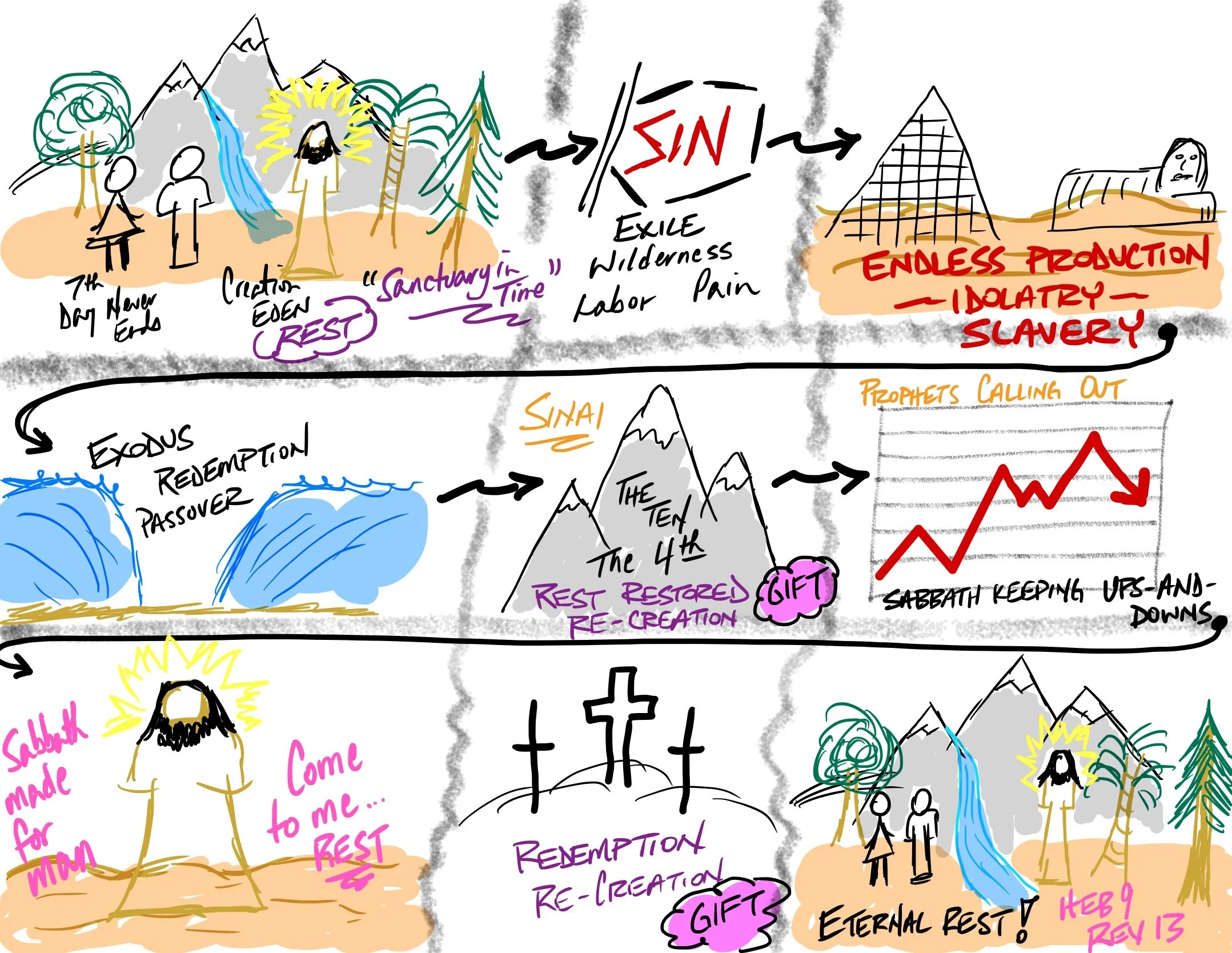
The Sabbath Through The Scriptures
What the Sabbath Is
Exodus 20:8-11
“Remember the Sabbath day, to keep it holy: 9 You are to labor six days and do all your work, 10 but the seventh day is a Sabbath to Yahweh your God. You must not do any work—you, your son or daughter, your male or female servant, your livestock, or the resident alien who is within your city gates. 11 For Yahweh made the heavens and the earth, the sea, and everything in them in six days; then he rested on the seventh day. Therefore Yahweh blessed the Sabbath day and declared it holy.”
To answer the question of whether or not we’ll take this day, we should first define exactly what you’re taking, what the day is. “Remember the Sabbath day…” So the first thing Yahweh is instructing us to do is to remember Sabbath, and remembering means looking back on something. In this case a day. And the question is: where are we looking back to?
It starts at Creation. Remember that God created the world and all that is in it, including us, in six days, God with us in the garden of his creation. Each day he’d declared “the evening and the morning” as one day. But then on the seventh day, the Bible tells us that God did one final piece of work — he actively, purposefully, ceased. He stopped. He rested in and with his creation. And he did something he’s rarely (if ever) done elsewhere — he blessed time, the seventh day. He created a sanctuary in time of rest, peace, and shalom. God was the originator of the rhythm of work and rest. And unlike any other day, this day was not bounded by evening and morning language. This sanctuary of time was endless, God with his people in rest and shalom.
But then, SIN and the Fall. Exile from rest. Wilderness, difficult labor for man, painful child-labor for woman.
Fast-forward to God’s people in the land of EGYPT. The wilderness. Work is now not merely hard, but it is slavery. Endless production, the idolatry of more, more, more. No rest. No shalom.
But God hears the cries of his weary and broken-by-labor people, and the EXODUS is his answer. Redemption is secured, passover and its lamb is to mark it forever, he’s bringing his people back into covenant and a land.
SINAI. The Ten. And the 4th, among them, lesser than only the commands regarding God himself. Rest is restored. Slavery is broken. No more ceaseless labor. No more endless production. Instead, re-creation. God’s people as ambassadors of the creation ideal. What a gift!
Highs, and Lows. The up and down of receiving the gift. Prophets calling out to people to remember what was their inheritance…Isaiah 58:13-14 “If you keep from desecrating the Sabbath, from doing whatever you want on my holy day; if you treat the Sabbath as a day of joy, God’s holy day as a celebration, if you honor it, not going your own ways — making money, running here and there — then you’ll be free! Free to delight in Yahweh! Oh, I’ll make you ride high and soar above it all! I’ll make you feast on the inheritance of your ancestor Jacob! Yes — Yahweh says so!” Sadly, their record in receiving this gift of rest, of a sanctuary in time, is pretty lousy.
And then, into this story God enters once again, in a new way — incarnation! — the Son of God himself stepping onto the scene, walking out of the wilderness, beginning his ministry, doing what? Remembering and celebrating Sabbath. Declaring, “Come to me, and I will give you rest.” Proclaiming to people confused about Sabbath, not rightly receiving the benefits of Sabbath, turning Sabbath into burden and not joy — “The Sabbath was made for man, not man for the Sabbath.”
And this Son, Jesus, seeing the slavery of humanity, knew his work as the final Passover Lamb was to bring rest through redemption purchased on a CROSS.
Re-creation, all things made new. Gift. Grace. Peace. Shalom. Rest — “Lay your deadly doing down, down at Jesus feet; rest in him and him alone, gloriously complete.”
And now we live in this time between two ages, and though we have seasons of rest, they feel unfulfilling, unsatisfactory, incomplete. We sense that there is more than we’ve tasted. We sense this because we live in an already, and not yet. For there is a final rest, an eternal rest, to come. A full restoration of what was, a promise of a rest — a Sabbath rest — that yet remains for God’s people, a rest that we must make every effort, God helping us, to enter into (Heb4). A new heavens and new earth, a new creation, where, “says the Spirit, ‘They will rest from their labors.’” (Rev14:13)
Brothers and sisters, this is the Sabbath! This is the rest that Yahweh wants us to remember every Sabbath day — this vital and crucial thread of rest, this promise of rest, throughout the Scriptures and throughout history and throughout our lives. It should thus come as no surprise that this is the most quoted of The Ten in all of Torah, why elsewhere in Moses’ writing he calls it sabbat sabbaton — a most restful rest (superlative, like ‘holy of holies’). And family — this is a gift, and not a burden. Remembering this means looking back and looking forward at something foundational to God, God’s people, and what it means to be truly human.
But ‘remember’ in the Bible doesn’t just mean to look back or to merely call to mind. Everyone with a birthday or anniversary knows more is needed. Remembering means action, remembering means keeping, observing, and as regards the Sabbath, consecrating.
If you’d like to check out the whole sermon, just click here.